Friday, October 7, 2011

Biomass Energy??

Aesthetically, fireplaces are always nice. They even feel warm when you're up close. But I've always known they're terribly inefficient. After all, most of the heat goes straight up the chimney--around 80%. The real score could be even worse, because the rising hot air has to be replaced by cold air pulled in somewhere through the building envelope, which can make other rooms colder (per MythBusters test - but see discussion).

Last year while talking to a friend, he told me of seeing a fireplace insert that could easily heat the whole house. I started investigating and found that modern fireplace inserts are not just a little more efficient than open fireplaces--they can in fact be quite efficient and generate large amounts of heat.

In the current climate of energy-consciousness, along with the modern efficiencies of wood stoves and fireplace inserts comes a fancy newfangled term: biomass heating--which simply means the recovery of energy recently captured in biological material. It's what people have been doing for millennia, but now made chic. Biomass stoves can either burn traditional sticks of wood or wood pellets made of compressed sawdust. Pellet stoves can potentially be more efficient because the burn rate can be micromanaged: they have a hopper and conveyor belt that maintains the rate of new fuel added to the fire. The downside of pellet stoves is that the conveyor belt stops when the electricity goes off; also, you can't grow your own fuel.

The EPA (Environmental Protection Agency) serves a useful role when it comes to biomass stoves by providing standards and a certification of how clean the stoves burn. As opposed to regulation, this is information that permits you and me as consumers to compare complex and difficult-to-evaluate competing products. A fireplace insert is really just a wood stove that fits into the fireplace opening, so the list of certified "stoves" includes inserts as well.

So last spring we ordered two fireplace inserts--one for our home and one for the office. We went with a mid-range model from Napoleon (1402) that runs around $2,000 installed by Eric Harton (see his website). If you are out at the State Fair of Texas in the next few weeks, drop by his booth at the Embarcadero building booth #27. A nice guy who does good work.

Objections overcome
The smoke-filled air in Congo
obscures the world's largest volcano
--just 10 km away.
When I first started looking into biomass heating, I had no idea biomass could be a serious 21st century fuel. After all, I've seen mountain air painted gray by the smoke of cooking fires in Congo. It seemed so quaint--but especially dirty. So, there are several intellectual hurdles to overcome:
  1. "Doesn't biomass energy pollute the air with dirty smoke?"
    If you see and smell smoke from your neighbor's chimney, you can be sure they don't have an efficient wood-burning insert. Even older wood stoves or inserts produce 15 to 30 grams  per hour (gph) of particulate matter. An efficient stove produces a little smoke only in the first 15 minutes while it is warming up--then the visible smoke disappears. EPA certification requires less than 7.5 gph, with most new stoves scoring under 4. Our Napoleon model is rated at 3.5 gph.
  2. "Aren't we supposed to be planting trees? Cutting down trees can't be green."
    Except that it can be done sustainably. Replant trees and they will grow. Grow your own fuel. I planted many trees at my office (our old house) 10 to 15 years ago. Just from trimming them they provide a lot of wood. Look at how many tree trimmings go to the landfill each year. That's wasted biomass fuel. It's better to burn it instead. Some of our own trees need to be cut down soon because of overcrowding or because they're starting to shade our solar array. I plan to replant trees in the back of the yard just for fuel.
  3. "Burning wood is inefficient."
    It's true that an open fireplace radiates at best 25% of it's heat into the room and sends the rest up the chimney. A wood stove reverses the heat loss, giving off as much as 85% or more of it's heat into the house. It does this by slowly burning the wood at a high temperature of around 550°. The oven bricks heat up and slowly cook the wood. In addition, super-heated jets of air provide fresh oxygen to re-burn rising smoke before it actually leaves the oven. (There are also catalytic models that achieve slightly higher efficiencies. But these also add a couple hundred dollars of cost every few years to replace the catalyst, which is fragile and also subject to premature breakage.) In addition, electric blowers in most models circulate air around the stove and disperse the heat into the house. This is one point at which I think the stove makers could improve--why not use an external combustion engine (a Stirling engine) and just use the heat of the stove to power the blowers?
  4. "Doesn't burning wood release carbon into the atmosphere?"
    Tree's capture carbon and the sun's energy, and burning them releases the energy for use and the carbon back to the air to be recaptured by new trees. If dead trees rot instead, the same carbon is released back into the atmosphere. Either way, there is a closed carbon cycle. The issue raised with fossil fuels is the release of carbon back into the air that has been sequestered for millennia--potentially upsetting the current balance of components in the atmosphere.
  5. "Can you really heat a modern house with wood?"
    Look at the BTU/hour rating of a stove. Compare your furnace rating. A small gas furnace may put out 50,000 BTU/hour. Our Napoleon stove is rated at 11,400 to 70,000 BTU/hour--it depends greatly on the type of wood burned and how much you stoke the fire. Hard woods contain more heat content and will burn longer. Of course, a home's architecture affects how much of the home one heating "appliance" will warm. In general, biomass fuel will be considered a secondary and emergency source of heat by most users. But it could be quite a substantial source.
Payback period 'guestimate'
Currently I have no hard data to go on for our houses. I can only speculate. What if 50% of our heat this next winter could come from wood? For our home that would amount to $320 saved in our gas bills; for work that would be closer to $200. Subtract out the $100 each I spent to deliver 1/2 a cord (4' tall by 8' long stack) of wood at each location, and the savings is relatively small. The payback could be 10 to 20 years. However, I expect to be much more comfortable at the office because I will relax the extreme austerity measures I've implemented the last few years! And there is the ambiance to enjoy. I'll report back in the spring after we have actual data about savings at home and at the office.

The Hearth, Patio and Barbecue Association provides a calculator to give some sense of the relative potential cost savings of adding a new biomass stove. It's interesting and based on some 'typical' situation, but clearly there are more variables than just the cost of the new fuel vs. the cost of the old fuel. Especially critical is the question of how much the family actually makes use of the new 'appliance' (stove or insert).

After all, there's work involved in stoking the fire. But if you enjoy your fireplace anyway, it's a matter of enjoying more fruit from your labor. A good stove will burn the same amount of wood much longer because it burns the wood more slowly and thoroughly. Many stoves have a stated burn-time of 9 hours or so.

And what about splitting wood? Does that count as chores or exercise? Maybe both. For a city dweller, buying a new maul (the proper tool for splitting wood) and learning the technique for the first time brings a feeling of accomplishment. Even my younger son found it a challenge to see if he could split wood with one blow. It certainly gets one out-of-doors for a bit and builds a connection with God's creation--kind of like a campfire experience. You can't get that from a cold--or hot--furnace.

Tax Credit
Finally, biomass stoves are a beneficiary of recent green initiatives at the federal level. They are eligible for a 2011 Consumer Energy Efficiency tax credit of $300 if their thermal efficiency rating is at least 75%. While the emissions level of an insert is easy to identify on the listing of EPA-certified stoves, the thermal efficiency rating is harder to nail down. The EPA listing appears to show a set efficiency rating for all stoves by class: 63% for non-catalytic wood stoves, 72% for catalytic, 78% for pellet stoves. Manufacturers, however, often list efficiencies well above 80%. Apparently the tax credit efficiency rating must be certified by and obtained directly from the maker. Our Napoleon inserts are certified at 78.83% efficiency.


Peter followed Him at a distance, right into the high priest's courtyard. He was sitting with the temple police, warming himself by the fire. (Mark 14.54, cf. Luke 22.55-57)

Monday, September 19, 2011

Open Window "Policy"

The record-breaking summer of 2011 (hottest average in the nation) is seemingly over for DFW. Everyone knows this year holds second place to 1980 for the longest continuous streak of 100° days. But it now holds record for the greatest number of 100° days (70 days as of September 13). And, just as important for electric load, 2011 holds title to the most days with daily lows above 80° (40 days as of August 17).

Free Cooling
But now with the lows falling into the 60's, it's time to take advantage of some cool natural ventilation. Until this year, I've generally kept my office closed up tight and depended solely on the central a/c to do it's job. But this spring I thought I'd try taking advantage of some of the cooler days and nights in order to run the a/c less. Each morning I would throw open my office window and open the sliding door in back and let the cool breeze blow through. No fan needed, and the a/c could wait till later in the season--or the day.

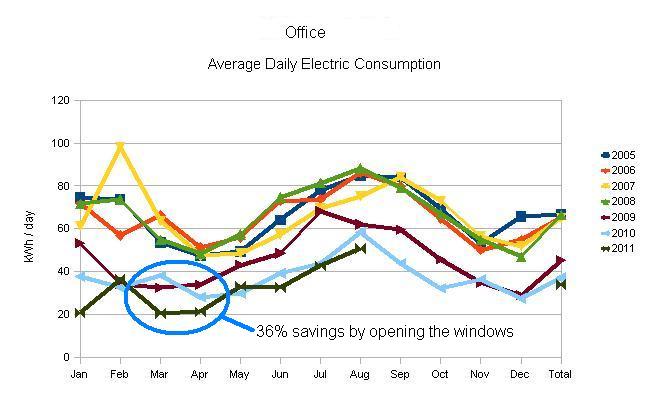
The result? A clear savings in electric consumption as compared with the past two years. The graph below shows a 36% reduction in electric usage for March and April. The brown line is 2009, the light blue is 2010, and the dark green is 2011.

Opening the windows was the only major difference between these years, so this simple zero-cost action accounts for the total reduction in electric usage shown. The daily average fell from 33 kWh per day to 21 kWh. That's a monthly savings of about 360 kWh (= 12 kWh/day x 30 days), or a savings of roughly $36 a month (based on 10¢ per kWh). That's $1.20 a day I'm being paid just to open the windows(!) Or $144 per year if the savings can be replicated for two months this fall. We'll have to wait and see--it's time to start saving.

By the Numbers
Though our electronic gadgets cost plenty of electricity, we can also put them to good use to save energy. I never trust myself to judge the temperature outside accurately--I always use a thermometer. I keep a wireless thermometer in a shady place out back with the inside read-out in a convenient place near my thermostat. It makes for an easy and accurate way to determine when to open the windows and when to close them.

The weather forecast is also useful. If the projected high is in the low 80's (depending on your personal comfort zone), you can plan to leave the house open all day. Remember that fans can make the afternoon comfortable as needed.

My own rules of thumb:

Forecast High Action Plan
above 83° 5° difference needed to open windows
close at 75° to 77° *
83° or below open all day
* Based on a/c thermostat set at 82°


In a home setting, of course, the windows can open up all night, giving an even better temperature differential and additional time to cool the house down.

The Downside
Humidity. To maximize comfort and minimize energy consumption, indoor humidity levels need to be 30% to 50%. The a/c dehumidifies the air when it first comes on, but it has to work harder to do so. This is why I've built a 5° minimum temperature difference into the rules above. On any given morning the outside humidity may be well above 50%. One could pay close attention to this detail and refine the rules further--but then they would cease to be rules of thumb! The 5° differential has served me well.

The Tremendous Added Upside
There's a joy in the journey, and a lot of enjoyment to be had from God's creation! The call of birds, the rustling of leaves, the refreshment of a gentle breeze. I remember back to college when I lived in unairconditioned dorms built back in the 30's (1930's that is, and I lived there in the 80's). Some of the best times I've had with the Lord were spent reading God's Word at my desk before an open window, with a cool breeze on my face and the dawn gently breaking outside. It was in those quiet times during my first semester at UT that I truly felt the Lord calling me to missions in the future.

Why have I kept these gifts securely locked outside my windows all these umpteen past years since? Convenience. Just a minute or so of saved time. Ugh! I'm glad for the change back to a lost joy.

So change your minds and turn back, that your sins may be wiped out so that seasons of refreshing may come from the presence of the Lord. (Acts 3.19)

Tuesday, August 23, 2011

The #1 Rule of Thumb

The #1 rule of thumb about electric power usage that everyone should know is simply this:


1 Watt = $1 (per year)*


For example, it costs $100 to keep a 100 Watt bulb burning for an entire year. Wow! That's a rule any first grader can grasp. It's precisely true when electricity costs 11.4 cents per kilowatt hour (kWh), and has been a useful rule of thumb over the past decade and at the present here in Texas. 


Adjustments for differing rates
So you want to be a little more precise for different electric rates? A quick adjustment will do:
Electric Rate per kWh 1 Watt all year =
6¢ $0.50
11¢ $1
17¢ $1.50
23¢ $2


The $77 CFL savings
I used to see $7 CFLs (compact fluorescents) that claimed "this bulb save you $77," and thought I should take that claim "with a grain of salt"--until I applied the above simple rule of thumb. Can one CFL "100 Watt equivalent" bulb really save $77?? Absolutely! Most CFL bulbs are rated to last 10,000 hours, a bit more than 1 year (which is 24 hours x 365 = 8,760 hours). The 100-Watt-equivalent CFL uses only 23 Watts, so it costs $23 of electricity over it's lifetime. Meanwhile, it's replacing 100 Watt bulbs (it would take about 4 replacements during the year) which would have burned up $100 of electricity. So the electricity savings is $77 for one bulb! I'd never have believed it till I did the math myself.


At this rate of electricity savings, how much the bulbs cost is of no consequence--especially since good CFLs can be found for around $1.50--barely more than a single incandescent. (More to come on the best CFLs available.)


So what's all the silliness about Joe Barton defending the energy hog incandescent? The rhetoric about personal freedom is misguided at best, and is largely a defense of pure and simple ignorance. The real freedom that's at stake is the energy independence of our country--which in turn contributes to our national security and ultimate personal freedoms!


So get rid of the incandescents in your home and office and bring in the CFLs immediately. It doesn't make any sense to wait until the incandescents burn out. I know of nothing better to do with them than to throw them away. They're simply burning through money every second they're on. 


Changing light bulbs is the main contributor to the 20% reduction in electricity usage at our home over the past year (see the light blue line in the graph below).


More Examples
Here's a few more observations based on the 1W = $1 rule of thumb:
  • A 10-year old 120W computer that's been left on continuously has cost $120 per year, or $1,200 of electricity to-date--more than its original cost.
  • A 3.5W clock radio costs $3.50 per year, or $35 over 10 years--several times its cost.
  • An electric piano with a power cord that uses 4.1W when the piano is "on" but still uses 2.9W when the piano is "off" costs at least $2.90 to leave plugged in all year. Not terrible, but a needless waste of power. There are better ways: unplugging it, using a power strip with a switch, or using a newer power cord that uses 0W when not in use. 
  • An old and inefficient UPS (Uninterruptible Power Supply) used 22W of power continuously. A new green UPS model uses only 2.4W of extra power--a $20 annual savings.
  • A fan running at 30W costs $10 if run constantly for 4 months of the year ($30 x 4/12). But if it's only used 8 hours a day for 3 months, it costs only $3.33.  
So this #1 rule of thumb simply puts energy costs in perspective. It makes energy use concrete and measurable. It's much more meaningful to tell the kids to turn the light off not just because "You're wasting energy," but because "That's $23 you left burning there." You can explain it really costs $23 if they leave that CFL on all year long. They get the message. And for the forgetful kid you can throw in a "$1 fine" (or other realistic amount relative to the size of his allowance) for leaving the light in his closet on. It'll bring a smile to his face (sort of) every time you catch him with the light on!
"Make the most of your opportunities because these are evil days." (Ephesians 4.16)
PS: Remember to recycle your spent CFLs. Both Home Depot and Lowes provide CFL recycle drop boxes just inside the entrance. 

* The specific math is this:
1 Watt x 24 hours/day x 365 days/year / 1000 Watts/kW x $0.114/kWh = $1.00/year

Tuesday, August 2, 2011

Equip Green - Stewardship for the King

My friends have come to know I'm rather passionate about my energy conservation and other green measures. There's my Prius, of which I can carry on quite a one-sided conversation! There's my solar panels from Solar City, which are a great economic value based on my lease provisions. Or the new LED lights I put in our living room.... And the list goes on.


In truth, my passion is not just about energy. It's about good stewardship. The classic concept that none of this stuff is really mine--it all belongs to the King, and I've just been entrusted with it for a short while. In the Old English sense of the word, I am a keeper of the pigs - a warden of the sty - the sty-ward = steward. OK, so I don't have many pigs to keep, but God has entrusted me with a whole lot of other stuff to keep up with:
The earth is the Lord's - and all it contains! (1 Corinthians 10.26)
God's age-old principle of blessing is simple: he blesses us so that we can in turn bless others. When God called Abraham to follow him, 

I will make you into a great nation,
I will bless you,
I will make your name great,
   and you will be a blessing. 
I will bless those who bless you,
I will curse those who treat you with contempt,
   and all the peoples on earth
   will be blessed through you. (Genesis 12.2-3)
To put it another way: grace begets gratitude. God gives to us, and logically we return thanks. In fact, in the Greek of the New Testament, the word charis can mean either grace or gratitude - one word encompasses both sides of this reciprocal relationship of giving and gratefully receiving. 


So I've always thought the color of a good steward is green. And blue too - because water is such a precious gift for us to make wise use of. But how is this conservation consciousness tied in with the ministry of Equip Disciples with its focus on equipping church leaders in rural parts of Africa and other parts of the globe where theological education is in short supply? The ways are multiple:

  1. Good stewardship is a basic element of theological discipleship. Stewardship is one aspect of what we teach in leadership conferences. 
  2. Being a wise steward of God's resources stretches every dollar so we can do more for the King.
  3. I have seen in person how our over-dependence on oil in the USA, plus some ill-advised mandates for mixing ethanol in our gas, has raised the price of corn and heightened food shortages around the world in Kenya. The law of unintended consequences is pernicious in a global economy.
  4. Many of the practical things we learn here about conservation of energy or water can be translated directly to developing economies around the world. Such as the need to pick a laptop based on its battery life. Other technologies such as solar panels, have practical corollaries such as simple solar ovens, which could be a tremendous economic boon to a household that spends 20% of their income on cooking fuel.

And so I've set out to publish Equip Green to convey practical ideas for going green for the King. I will share from my personal journey - both what works and some mis-steps. 
For example, at my office, the last 7 years have exhibited good progress in reducing electricity consumption. Years 2005 through 2008 all averaged about the same usage. Then 2009 fell well below those years, then 2010 (the light blue line) dropped down further, and the incomplete line on the very bottom is 2011. Usage in winter and spring has been cut by more than half, and summer and fall usage is cut by more than a third. And how did I do that? Changing light bulbs and small computer-related appliances, shutting down one computer, changing out the refrigerator, and attention to details. More on each of these points later.


May God bless you so you may bless others!